Showing posts with label POSTAL | APO 640 1st (US) Base Post Office. Show all posts

Wednesday, 9 June 2010

Summary Site History at 09.06.2010


Summary Site History

The site appears to be part of the 93 acres given to the Warden and Society of the Royal Town of Sutton Coldfield by Sir Edmund Cradock-Hartopp of Clifton of Four Oaks Hall in November 1827. [1]

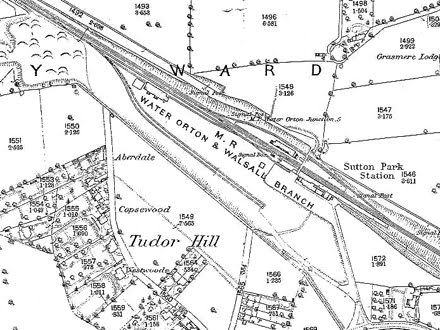
Unlike the rest of this land, which had become available for residential development from the early 1860s, the site was used for the construction of the Midland Railway Company's Sutton Park Line and Station between 1875 and 1879. The natural slope of the site was levelled as part of the construction works. [2]

The new Sutton Park Line made cheap coal available to the residents of Sutton Coldfield, and it appears that the site was primarily designed for the storage and distribution of coal. The existing 'Goods Shed' was equipped with two 30cwt cranes to lift coal from the wagons. An almost identical building was constructed by the Midland Railway in about 1865 at Bakewell, Derbyshire. The 'Goods Shed' is associated with the Billson family coal merchants [3], who had moved to Sutton Coldfield from Aston on the opening of the Sutton Park Line in 1879 and were still active on the site until at least 1912.

The 'Goods Shed' is subsequently associated with C. H. Crees and Sons, builders merchants, now located at Green Lane, Aldridge. Other families and trades identified with later buildings no longer on site but recorded on the various OS maps include: Bassett & Sons, Shell Mex depot, Pratts depot, G H Dykes coal office, and Davenport & Co.. [4]

Between July and October 1942, the 'Goods Shed' was used by 640th US Army Postal Unit. The US military 'mail distribution scheme' was then "moved 50 yards to a building being completed especially for our purposes. ... The new building containing 52,000 square feet of floor space... A double railroad sidetrack parallels the 380 foot post office platform." [5]

By the end of World War 2, the 1st US BPO/APO 640 installation comprised "75 buildings, widely scattered" [5] including the airports at Fradley and Castle Bromwich, New Street Station in Birmingham, the V-Mail Section in London (from early 1944), and the various barracks, billets, and messing arrangements established in the wider Sutton Coldfield area. [6]

In 1947, the British Army Postal Services (Home Postal Centre RE) moved from Nottingham into the vacated US 1st BPO in Sutton Coldfield. [7]

From 1948, the site was used by the General Post Office for foreign postal services. In August 1957, the GPO Sutton Park Station depot processed the First Day Covers posted to mark the 9th Scout Jubilee Jamboree held in the neighbouring Sutton Park to celebrate the centenary of Lord Baden Powell's birth. This was the first time the Post Office produced special rolls of stamps designed to service first day covers automatically. [8]

For the period from the mid-1990s to the opening of the Heathrow Worldwide Distribution Centre (HWDC) in November 2003, the site was known as 'Birmingham Z' and handled all surface mail within the national network of seven 'Offices of Exchange' (OEs) dealing with export mail. [9]


Notes:

1.
This land included "two closes of land and the greater part of the third close of land (called 'The Moors') adjoining Sutton Park and to the New Forge Pool." In exchange, the Warden and Society of the Royal Town of Sutton Coldfield gave Cradock-Hartopp 63 acres and 31 perches of Sutton Park ("a slip of land adjoining Four Oaks Park and the greater part of Lady Wood and land adjoining") to allow the then owner of Four Oaks Hall Estate "to create a more pleasing oval shape to his deer park". The exchange also obliged Cradock-Hartopp, at a cost of £1000.00, to build a new entrance to the Park (the present Town Gate) and a new road (Park Road) linking the town to Sutton Park. Reference Birmingham City Archives MS 3069/Acc1935-063/443143, 16 November, 1827.

The site was previously in the ownership of Wriothesley Digby of Meriden [ref. Deeds of Four Oaks Hall Estate 1751-1831, Birmingham City Archives MS3069/Acc1935-063/443140] via the Will of Sir Lister Holte, 5th Bt, on his death in 1770 [ref. Birmingham City Archives MS 3369/Acc 1961-9/39a&b 1758-1769].

2.
Following an earlier investigation in 1865 ("abandoned due to monetary pressure"), Sutton Coldfield Corporation appointed a Railway Committee in January 1872, and the Act of Parliament (35 & 36 Vict.) was passed later the same year. The line was staked out in May 1873, construction began in the Spring of 1875, and the 'Sutton Park Line' finally opened for business on the 1st July 1879. The Railway Company paid £6,500 for the 2-mile long strip of land across Sutton Park, and the cost of the construction of the 8-mile line rose from an estimate of £175,000 to over £400,000. The contractor was the "highly respected" railway engineer Joseph Firbank.

3.
Kelly's Directory 1896: "Billson Jn. Park Station (Midland Ry) depot", listed under 'Coal & Coke Merchants'.

4.
There are remains of the silos used for materials storage/distribution in the small wooded area to the east of the site. It is not known if these are related to coal or building supplies.

5.
Major Benjamin F. Hartl: 'History of First Base Post Office', October 1944.

6.
In all, about 1000 different APOs (Army Post Offices) were in use during the period between 1941 and the end of 1945.

7.
Royal Engineers Museum http://www.remuseum.org.uk/specialism/rem_spec_pcsww2.htm (09.06.2010).

8.
Two machines developed by Vacuumatic Ltd of Harwich were hand-fed the covers which were cancelled with the special postmark slogan “Jubilee Jamboree – Sutton Coldfield” and posted from the Jamboree Camp Post Office. This was the Post Office's first foray "into the highly lucrative FDC market".

Sources:

http://www.stampprinters.info/1957%20Scout%20Testing%20Label.pdf
http://www.thetenoclockshow.co.uk/content/view/152/43/
http://wapedia.mobi/en/Jubilee_Jamboree
http://www.sossi.org/maarsen/wjregmail.htm

9. The Postal Heritage Trust 2004.

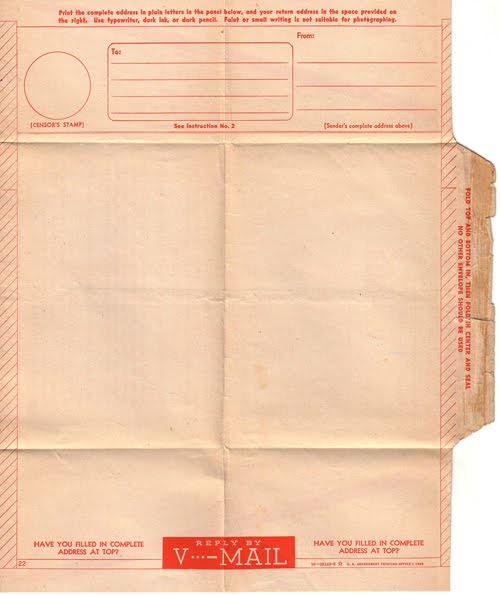
Blank V-Mail Form


produced by 'U.S. GOVERNMENT PRINTING OFFICE:1943'

Wednesday, 26 May 2010

Brick Bonds Background

A number of bonds are present across the site as well as some hybrids. For instance the goods shed is English Bond whilst the substation seems to be a variant of Flemish Stretcher.


Brick Bond map from 'England in Particular' published by Common Ground.

Site Brick Bonds

Remains of wall in woodland at east end of site.

DO building chimney.

Substation in visitor's car park.

DO building showing end wall (left) and side wall (right).

Goods shed.

Monday, 17 May 2010

Catch Up

The more immediate US Army sites are linked physically (or permanently) whilst the more distant (and overseas) connections are celebrated through something more temporary. This is where Mail Art can play its part by bringing many of these places back in to contact. The contemporary format, etc. of the work will highlight the passing of time since WW2.

One thing that the 'summary history' underlines is the complexity of the operation. Also its responsive nature to major WW2 events, movements of personnel and the theatre of war triggering its increasing expansion.

The extent of the original site and its pre-existing buildings express, in architectural and operational terms, the scale of the war as originally envisaged. The pre-1942 site maps the perceived scale of WW2 as the US initially saw it. Each additional building is triggered by an historic military operation, the equation being, for example, Normandy = 4 Romney Huts, and so on.

On the idea of enclosures and parcelling. Documents enclosed, land enclosed. Parcels of land for sale, etc.. Want to look at the structure of envelopes too, how they fold and enclose.

By way of clarification, Romney Huts and Quonset Huts refer to the same buildings in another example of two nations divided by a common language, see:

Thursday, 13 May 2010

Summary of 'History of 1st Base Post Office'

OBSERVATIONS

The Function:

The 'History' provides monthly totals of mail processed from February 1943 through to September 1944, although the APO had been activated from 01.08.1942 and been operational from 01.07.1942. These totals are for 'First Class' post, 'P.P. & Prints', and 'V-Mail'.

The Building:

It is quite clear that the 1st Base Post Office/APO 640 was a phenomenal feat of operational administration ("the Mail Distribution Scheme") delivered over 18 or so months from July 1942. In the reports for the final months up to September 1944, the emphasis is increasingly on social events and the establishment of the APOs in France.

Many Buildings:

1st Base Post Office/APO 640 is described in the 'History' as "an installation" comprising "75 buildings, widely scattered", and this installation was networked (literally) with places like Fradley (outside Lichfield), Birmingham (New Street Station), and beyond.

The Memory:

The 'memory' is to do with this administrative feat rather than the buildings which rarely managed to accommodate it. It is also to do with how Sutton Coldfield was networked into the bigger Midlands region and the wider European Theatre of Operations for about 24 months.


SUMMARY NOTES

The 'History of First Base Post Office' was written by Major Benjamin F. Hartl, Unit Historian, in October 1944, and is written on a month-by-month basis. It starts with the activation of the 1st Base Post Office at Fort Hamilton, New York, on 01.05.1942, and concludes with the shift of emphasis to APOs in France by late summer/early autumn 1944.


A. OPERATION/FUNCTION

page 4 [bpo0003.jpg]
10.
The transportation of mails in the United Kingdom was the responsibility of the British General Post Office (GPO). Their system for handling their mails is briefly as follows:

All first class mail is handled by post office staff at all railroad stations and junction points; that is, the staff is required to load this mail in baggage compartments of railroad vans and unload at destination and transfer of mails at junction points. Parcel post is turned over to railroad employees for loading, transfer and unloading.

page 5 [bpo0004.jpg]
14.
640th Army Postal Unit was activated 1 August 1942 and formed an integral part of the 1st Base Post Office. The Base Post Office used this APO number as part of this unit's address in order for the New York Post Office to readily identify mail thereafter as belonging to this theater.

page 6 [bpo0005.jpg]
Operations in the railroad shed grew quite congested during the month of August [1942] and it became necessary to load and unload sacks from railway vans and work some of the direct sacks outside of the building along the railway tracks.

page 12 [bpo0011.jpg]
31.
[January 1943] Mail was being received day and night at various intervals and corresponding dispatches were likewise made to the 37 APO's served at this time.

page 13 [bpo0012.jpg]
37.
The volume of transfer mail had increased to such an extent at the New Street Station in Birmingham that the British GPO employees could not handle it...

page 14 [bpo0013.jpg]
39.
Initial dispatch to APO 651 was made on 27 March [1943] making a total of 39 APO's served.

page 15 [bpo0014]
42.
The inauguration of an additional dispatch to APO 648 was started this month [April 1943] for the transmission of ordinary mail to the U. S. by air transportation...

page 26 [bpo0025.jpg]
76.
A total of 78 APO's were being served through the Base Post Office at the end of the year [1943].

77.
The New Street Station detachment had increased to 20 men and a regular service was established for the transportation of mail between the Base Post Office and Birmingham.

page 27 [bpo0026.jpg]
80.
Thirty-two new APO's established during this month [January 1944].

page 32 [bpo0031.jpg]
99.
Det. "A", 1st Base Post Office was organized to operate the V-Mail Station located in London.

page 7 [bpo0039.jpg]
(4)
600 new units were added to the Mail Distribution Scheme making a total of 7,700 units served by this installation. 160 Army Post Offices were functioning in the theater at this time.

page 13 [bpo0045.jpg]
(5)
700 new units were added to the Mail Distribution Scheme, making a total of 8500 units served in the ETO. 157 Army Post Offices were operating in the U. K. at the close of the months [May 1944].

page 19 [bpo00517.jpg]
i.(2)
A new section called the "french Section" was organized. This section handled the mail intended for dispatch to Normandy.

page 20 [bpo0052.jpg]
(3)
The mail distribution scheme at the close of June [1944] consisted of 90 pages, carrying a total of 8800 units, 1447 of which were in France.

page 27 [bpo0059.jpg]
(5)
The New York Port of Embarkation Army Post Office began the make up of Normandy mails in direct pouches to unit and serving APOs. This eliminated extra handling at this point and expedited the flow of mail across the channel. [August 1944]

page 42 [bpo0074.jpg]
(3)
The air mail service from Fradley Airdrome to the continent was not perfect due to a lack of flying equipment. At one time it was found necessary to move 30,000 pounds of first class mail by train to Southampton, thence by surface vessel to France.

(4)
The Annex buildings were completed during the month [September 1944]...

page 43 [bpo0075.jpg]
(7)
At the close of September [1944] 87 Army Postal Units were in operation in the United kingdom and 144 in France. The Continental Scheme showed 6,500 units and the United Kingdom Scheme showed 4,500.


B.
BUILDINGS & WIDER 'TRAIL'

page 5 [bpo0004.jpg]
19.
On 6th October 1942 the entire operations of the Base Post Office were moved 50 yards to a building being completed especially for our purposes. ... The new building containing 52,000 square feet of floor space... A double railroad sidetrack parallels the 380 foot post office platform.

page 10 [bpo009.jpg]
27.
Central heating and the lighting installation was in operation on 3 December 1942...

page 12 [bpo0011.jpg]
32.
Enlisted personnel were housed in school buildings, construction of which were not quite completed by the first year. These barracks are located one mile from the Base Post Office.

page 13 [bpo0012.jpg]
35.
... The security fencing around the Base Post Office and barracks was completed during this month [February 1943].

page 19 [bpo0018.jpg]
54.
The Wentworth House located 2 miles from the BPO was taken over for officers quarters on 11 August [1943]. ... The barracks and Base Post Office, although not quite completed, were taken over from the British on 23 August and 27 August respectively.

page 22 [bpo0021.jpg]
65.
...authority was granted to use 250 men messing centers which were being constructed in the vicinity for other troops. These centers included kitchen, a small mess hut seating 150 at one sitting, and latrine facilities. The 250 men were to be billeted in the area not exceeding one mile distance from the messing center.

66.
On November 3rd [1943] the Four Oaks Messing Center was opened and the billeting of men in this vicinity was started. This center is located approximately two miles from the Base Post Office.

page 24 [bpo0023.jpg]
68.
The Glenfield House...was finally completed and occupied on 17 November [1943].

page 25 [bpo0024.jpg]
74.
Penns Lane Camp, accommodating 250 men was occupied on 4 December [1943]...located approximately four miles from the Base Post Office...

page 26 [bpo0025.jpg]
75.
A fourth messing center was opened on 22 December [1943] in another section of the city called maney Hall District.

page 32 [bpo0031.jpg]
Wylde Green messing center for 250 men was established and began operations on 2 March 1944.

page 3 [bpo0035.jpg]
c.
Battalion Headquarters, formerly located at the Holland Road Camp was moved to Green Gables, a requisitioned mansion, located one mile from the Base Post Office [April 1944].

page 12 [bpo0044.jpg]
(1)
Ninety six feet of the new addition of Romney hutting was occupied during the month [May 1944]. Some congestion in the main building was thus relieved by working newspapers and periodicals in the additional space provided.

page 14 [bpo0046.jpg]
f.
On 4 June [1944] a detachment from 347th Engineer regt.,...reported at this station to construct a central 500 man kitchen, winterized mess tents, a women's rest room and a branch dispensary. ... During this month twelve men installed the kitchen drains and sewers... The hut proper was completed.

page 15 [bpo0047.jpg]
g.
The Post Utility Officer, First Lieutenant Robert W. Barkhols, AGD, 0-1179013, demonstrated outstanding ability in undertaking and completing the many projects necessary in an installation of this kind, comprised of 75 buildings, widely scattered. Although the men assigned to the section were not skilled craftsmen generally, the work performed was efficient and of professional standard.

page 18 [bpo0050.jpg]
h.(5)
The Casualty Section moved into a part of the new annex building...

page 23 [bpo0055.jpg]
h.
The Motor Transportation Section...has done outstanding work in providing transport for this installation. Practically all repairs are made at the garage and only body repair work requiring welding must be taken to an Ordnance repair depot.

page 28 [bpo0060.jpg]
c.
The Post Utility Section completed the Central Mess which began operation late in the month [August 1944]

d.
Two American type huts were procured and erected on a site adjoining the main Post Office building. Battalion Headquarters moved into these huts from Green Gables...

page 31 [bpo0063.jpg]
i.(1)
The addition to the post office consisting of 35,000 square feet of Romney hutting was occupied during the month...[September 1944]

Wednesday, 12 May 2010

Introduction to APOs

The USA joined WW2 on 8th December 1941 (the day after Pearl Harbour), but the 1st BPO (APO640 Sutton Coldfield) wasn't reconstituted until 1st May 1942, and didn't arrive in England until 16th June 1942. As it says below, the full system of APOs wasn't established until after Pearl Harbour.

Introduction to A.P.O.’s

Two fundamental facts - that soldiers in the field like to receive mail and that armies move, lead to the development of numbered post offices for military postal services. Add to those the value of anonymity of location for security. The practice did not begin in the United States or during World War II. It goes at least as far back as the Franco Prussian war in the 1870’s. The United States employed a system of numbered army post office during its role in the First World War.

The system of A.P.O.’s that serviced the army and army air corps during the Second World War began before the American entry into the war, and continues with some modifications through today. In the spring of 1941, President Franklin Roosevelt entered into an agreement with the government of the United Kingdom to exchange 50 destroyers for 99 year leases to establish military bases in several British Caribbean colonies. Army Post Office numbers were assigned to each of these new bases as the troops arrived to garrison them. The number of American servicemen stationed outside the boundaries of the continental United States increased during late 1941, and so did the number of A.P.O.’s. With the attack on Pearl Harbor, and the entry of the U.S. into the war, a full system of numbered A.P.O.’s was established.

In some cases there was a logical reason for a certain A.P.O. number to be used. For example, A.P.O.’s assigned to service infantry divisions were in most cases numbered the same as the division. The 1st Infantry division was assigned A.P.O. 1. In other cases, the A.P.O. number coincided with a regiment number. Certain geographic areas were assigned a series of numbers. For example, numbers 825 through 837 were assigned to specific bases in the Canal Zone, numbers 931 through 949 were assigned to Western Canada and Alaska, and numbers 950 through 966 were assigned to Hawaii. There were also other relationships between the A.P.O. number and sort of soldiers the A.P.O. serviced, but many A.P.O. numbers appear to have been assigned numbers on a random basis. In all, about 1000 different A.P.O.’s were in use the period between 1941 and the end of 1945.

http://www.postalhistory.com/Military/APO/index.htm


APOs in UK by number:

This is a list of all the US APOs in the UK I have discovered so far. There are lots, and I keep finding new ones! I haven't yet worked out which are WW2 or how any of these connect to APO640 Sutton Coldfield. And I may never understand all this. What follows is a labour of love through gritted teeth. It could be that APO640 Sutton Coldfield was the key distribution centre for all in coming and out going US mail during WW2 (the Collins' argument), or it was just one of many such key distribution centres (and I've seen various US military mail that is APO numbered but which hasn't gone through APO640 Sutton Coldfield). Who knows?

0001 England
0004 England
0005 England
0009 England
0010 England
0028 England
0028 Wales
0029 England
0030 England
0034 Northern Ireland
0035 England
0052 England
0056 England
0057 England
0058 England
0061 England
0062 England
0063 England
0067 England
0068 England
0069 England
0076 England
0078 England
0079 England
0080 England
0083 England
0084 England
0087 Scotland
0090 England
0094 England
0095 England
0099 England
0109 England
0110 England
0111 England
0115 England
0117 England
0118 England
0119 England
0121 England
0122 England
0124 England
0126 England
0127 England
0128 England
0128 Northern Ireland
0129 England
0129 Northern Ireland
0130 England
0131 England
0131 Northern Ireland
0132 England
0132 Northern Ireland
0133 England
0134 Wales
0135 England
0136 England
0137 England
0138 England
0140 England
0141 England
0143 England
0144 England
0145 England
0146 Northern Ireland
0147 Northern Ireland
0148 England
0149 England
0150 England
0151 England
0152 England
0153 England
0153 Northern Ireland
0155 England
0156 England
0157 England
0158 England
0160 England
0161 England
0162 England
0163 England
0164 Wales
0165 England
0166 England
0167 England
0168 England
0169 England
0170 England
0171 England
0172 England
0173 England
0174 England
0176 England
0178 England
0179 England
0203 England
0204 England
0205 England
0206 England
0207 England
0208 England
0209 England
0225 England
0226 England
0228 Wales
0229 England
0230 England
0231 England
0232 England
0243 England
0251 England
0252 England
0253 England
0254 England
0255 England
0256 England
0257 England
0258 England
0259 England
0261 England
0262 England
0270 England
0298 England
0302 England
0305 England
0305 Northern Ireland
0307 England
0308 England
0312 England
0314 England
0316 England
0339 England
0340 England
0348 England
0349 Wales, 4182 US Army Plant, Newport 1944 for 7 months
0350 England
0403 England
0407 England
0408 England
0409 England
0413 England
0417 England
0436 England
0437 England
0437 Scotland
0443 England
0448 England
0449 England
0451 Wales
0452 England
0454 England
0463 England
0469 England
0469 Northern Ireland
0472 England
0505 England
0506 Scotland
0507 England
0508 England
0510 England
0511 England
0512 England
0513 England
0514 England
0515 England
0515 Wales
0516 England
0516 Wales
0517 England
0518 England
0519 England
0520 England
0525 England
0526 England
0527 England
0528 England
0545 England
0546 England
0551 England at Botesdale (1943) then Hadden Hill (May 1944) and then finally at Tidworth (from August 1944)
0552 England
0553 England
0554 England
0555 England
0556 England
0557 England
0558 England
0559 England
0560 England
0561 England
0562 England
0563 England
0564 England
0568 England
0569 England
0571 England
0572 England
0578 England
0579 England
0580 England
0582 England
0584 Wales
0589 England
0592 England 18th Bomb Squadron 1945
0636 Northern Ireland
0637 England 8th Fighter Command Watford 1943
0638 England
0639 England
0639 Northern Ireland
0640 England, Whittington Barracks, Lichfield, 16 June 1942; Sutton Coldfield 30 June 1942 to April 1944; then London and then France.
0641 England
0641 Northern Ireland
0642 England
0642 Wales
0644 England
0645 England
0646 England
0647 England
0649 England
0650 England
0651 England
0652 England
0653 England
0654 England
0655 England
0658 England
0659 England
0696 England
0741 England
0742 England
0756 England
0757 England
0871 England
0872 England
0872 Wales
0873 England, Goxhill
0874 England, Whittington Barracks, Lichfield, 1941 - 1944
0875 England, Kettering
0887 England, London 1942 to August 1944
1116 England
1118 England
1126 England

Wednesday, 5 May 2010

Aerial Photos

Another note on this subject... In LfV there is one poor aerial photo of the site credited to the US Army. There are surely a whole load more aerial photos around of the site given the richness of military targets.

More 1st BPO

What was the structure that the photographer of the last one (184248) was standing on to get the height? Today it looks as though that something has been removed from here or is it from where the rail compound/yard is? Has part of the complex already been 'lost'?

Tuesday, 4 May 2010

Streetly Philatelic Society

1. For the last 15 years or so, the SPS has been building the 'Streetly Collection' which is all things to do with postal matters in SC.

2. Today's talk included various Francis J. Field memorabilia, plus what the Society has on the 1957 Scout Jubilee Jamboree in Sutton Park.

3. Last year's talk (Part 1) covered the Society's collection on the 1st US Base Post Office. It was a shame to have missed this, of course, but at today's meeting the SPS Chair announced that they have now produced a CD of all the US material.

Monday, 3 May 2010

Smithsonian

http://www.postalmuseum.si.edu/research/index.html#resources
http://www.postalmuseum.si.edu/victorymail/index.html

More from the US

First, the magnum opus on WWII postal operations is that entitled "The United States Post Office in World War II" edited by Dr. Lawrence Sherman and published by the Collectors Club of Chicago in 2002. It has a section that describes the functions of the BPOs but not the history or locations. This brings us to the second key reference, which is "Numbered Army & Air Force Post Office Locations, Volume 1" by Russ Carter and published by the Military Postal History Society in 2001.

Russ lists each of the BPOs with when and where they functioned, but the layout of the handbook doesn't provide much space for details. However, it does give key dates. As to BPO #1, it was activated at the New York Port of Embarkation on 4 June 1942, established at Sutton Coldfield on 30 June and began operations the following day.

Apparently, a Detachment A was sent from the BPO to London to operate the V-mail station there in the spring of 1944.

1st BPO History


Had this in from Russ Carter, the author of 'Numbered Army and Air Force Post Office Locations' in the States [see: http://www.militaryphs.org/pubs/apobook.html]. Some great photographs, and he makes the interesting distinction between 'Base Post Office' as 'the unit' or as 'the buildings'. Russ says:

Below is the unit history of the 1st BPO as in the book that I wrote:

1st BPO (machine and hand cancels reported)

Constituted in 3rd Corps Area 1 Jan 38

Disbanded 1 May 42


1st BPO reconstituted at Ft Hamilton, NY 1 May 42

Activated New York PoE 4 Jun 42

On Tegelberg (TAPO ?) 4 Jun 42

Liverpool, England 16 Jun 42

Whittington Barracks, England 17 Jun 42

Sutton Coldfield, England 30 Jun 42

Began ops 1 Jul 42

Det A organized to operate Vmail Station in London Mar/Apr 44

France??

On Gen Taylor 30 Jan 46

Camp Kilmer, NJ 11 Feb 46

Inactivated 12 Feb 46


Unfortunately I have nothing on the specific information that you are probably looking for. I do have several photos of the 1st BPO that I attach to this note.

photo 184248 Front of 1st BPO building 3/8/43

photo 184249 1st BPO directory service 3/8/43

photo 184261 1st BPO administration 2/22/43

photo 384770 sorting mail 9/27/43

Sunday, 2 May 2010

V-Mail


Finally found (but could not purchase) a V-Mail from APO 640 Sutton Coldfield...

Saturday, 1 May 2010

War Cover Club

A fishing expedition to The Military Postal History Society [http://www.militaryphs.org/]...founded in 1937 as the War Cover Club, American Philatelic Society Unit #19. The original club focused largely on the postal history of the American Expeditionary Forces in World War I. The group changed its name in 1991 to better reflect the wide variety of collecting interests of its members. It promotes the study of the postal aspects of all wars and military actions of all nations. Today members' interests include soldier campaign covers, patriotics, prisoner-of-war mail, naval mail, occupation and internment covers, picture postcards of a military nature, camp cancels, field post offices, propaganda labels and leaflets, V-mail, censored mail and similar related material.

Monday, 19 April 2010

More Questions

'Places are the rub between sites and people OVER TIME'. We don't just pin a site's identity to a handful of years for the same reason that we don't stop our investigations at the red line.

It was coal that seems to have been the 'bribe' to get people to buy the whole intrusion into the unspoilt wilderness of Sutton Park. This gave our site an area for rail/road interchange.

There were two or three possible routes for the railway through the Park, but this route was chosen as the line of least damage. There were also a number of conditions and these included council control over design of bridges, planting of ornamental shrubs on the embankments, and provision of a station on the west side of the park.

Friday, 2 April 2010

Repository


Agree with the website as a repository for findings but should it remain something that could be chanced upon or do we advertise it through various fora, local media, etc.? Like the idea that the website becomes a sorting office in itself, filling up with all manner of information and then we direct it to where that knowledge is required.

From reading LfV the main thing to glean is the thorough integration of the Americans into the life and landscape of Sutton Coldfield (not always welcome but the book on the whole does make it sound quite rosy at times). This firmly supports the need for the work to spread out from the site. What about a treasure trail of things that could be visited / collected with the idea of letterboxing in mind, see: http://www.dartmoorletterboxing.org. Participants could collect the 'stamps' to get a reward. The stamp designs being artworks in themselves.

Keen (as always!) to bring in the natural history side of things and feel that there are a few options at the wooded end of the site. Maybe as simple as putting allotments back there for rental by people who live on the development. But this area could also act as a bridge to the theme of the Park.

Wednesday, 31 March 2010

Mail Art

This could be a 'mail art' project of some kind. Looking at the Wikipedia definition (!), mail art is linked to first day covers, etc. (which connects us with Francis J. Field nicely) and it would be nice to do something Fluxus-like with the International Union of Mail Artists and the like, and also reference:

http://www.actlab.utexas.edu/emma/Gallery/galleryjohnson.html#TRIBUTE

http://www.rayjohnsonestate.com/newyork.php

Maybe we should produce a First Day Cover for the July consultation event, thus shifting away from 'researching' the subject to 'using' the subject, see: http://www.spareroom.org/mailart/arch_ess.html

Other things worth reading:
http://www.kg6gb.org/services_mail.htm

http://www.tafsc.com/PostalHistory.htm

Thursday, 25 March 2010

Introduction


Letters for Victory

"Mail and morale go hand in hand," so said Lieutenant Jordan, one of the first American officers to be based at the First Base Post Office in Sutton Coldfield, Warwickshire. He was right, imagine how you feel when the postman drops a letter from a friend through your letterbox and imagine how the American soldiers, based over here in Britain thousands of miles from home, felt when they received a letter from friends or family. The importance of having an efficient mail system should not be underestimated in building up morale and aiding the war effort.

http://www.englemed.co.uk/books/usaaf/